Axle Gearing and Speedometer Calibration Guide
November 29, 2026
Bigger tires are one of the first upgrades most Jeep Cherokee XJ and Comanche MJ owners make, and they quietly change two things: how hard the engine works to turn the wheels, and how fast the speedometer thinks you're going. This guide covers how to find your current axle ratio, how to pick a new one for your tire size, and how to correct the speedometer afterward.
Why Tire Size Changes Everything
A taller tire travels farther with every turn. That has the same effect as installing a lower (numerically smaller) axle ratio:
- Performance: The engine turns slower at any given speed, so the Jeep feels sluggish, struggles on hills, and the automatic hunts between 3rd and 4th.
- Speedometer: The speedometer counts driveshaft turns, not tire turns, so it reads slow. On 31" tires a stock XJ showing 60 mph is really doing about 66 mph.
- Odometer and cruise control: Both use the same signal, so they're off by the same amount. On automatics, the transmission's shift points shift too.
Regearing fixes the performance; a speedometer gear change fixes the readings. You usually want to do both.
Finding Your Current Axle Ratio
- Axle tag: Look for a small metal tag under one of the differential cover bolts. It's stamped with the ratio (for example "3.55" or "3 55"). Tags get lost or swapped over the years, so confirm with another method.
- Count the turns: With the Jeep in neutral, the transfer case in 2WD, and one rear wheel off the ground, mark the tire and the driveshaft. Turn the tire exactly one full turn and count driveshaft turns. With an open differential, one wheel turning gives half the ratio, so double your count (about 1.75 turns = 3.55). With a limited slip or locker, lift both rear wheels and turn both together; the count is the ratio itself.
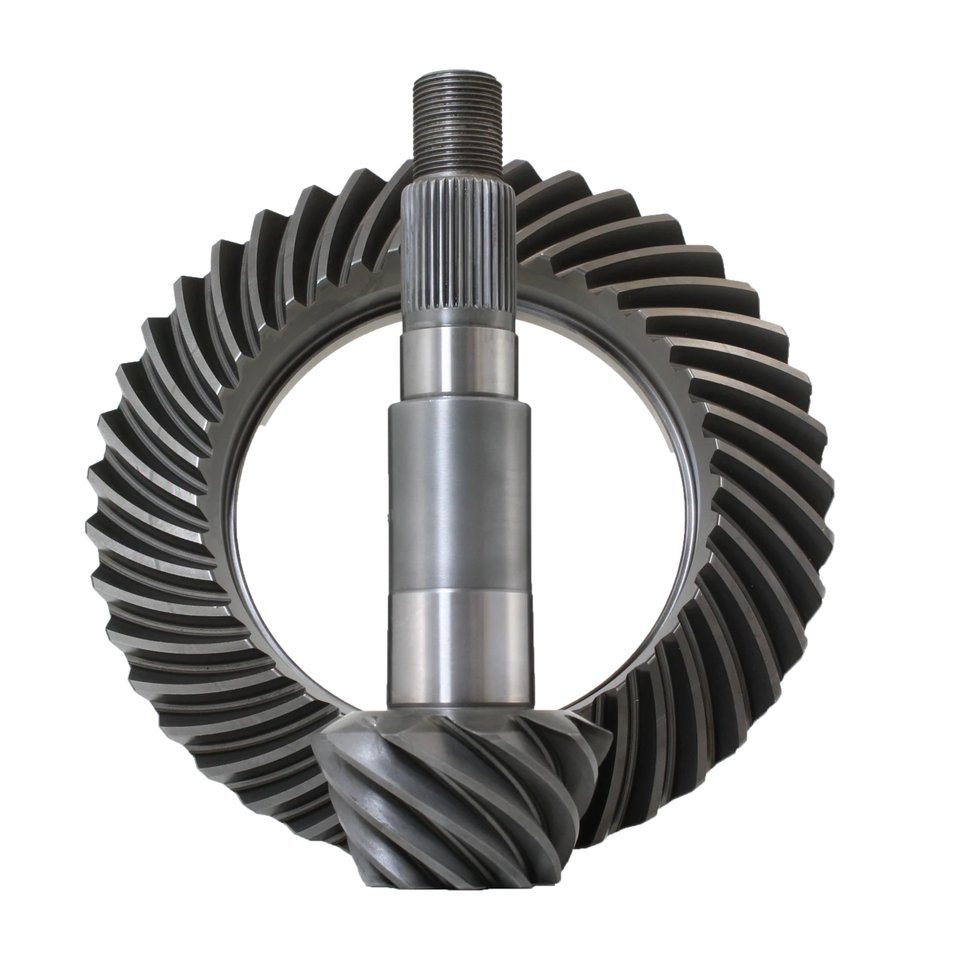
- Gear markings: If the cover is off, the ring gear is stamped with its tooth counts (for example "41-11"). Divide the first number by the second: 41 ÷ 11 = 3.73.
Common factory ratios on the XJ and MJ are 3.07, 3.55, 3.73, and 4.10. Generally, 4.0L manuals came with tall 3.07s, 4.0L automatics with 3.55s (3.73 with some towing packages), and 2.5L four-cylinders with shorter gears. Don't assume: always check, and check both axles.
Choosing New Gears
To get back the factory feel with bigger tires, scale the ratio by the change in tire diameter:
New ratio = Old ratio × New tire diameter ÷ Old tire diameter
The stock 225/75R15 tire is about 28.3" tall, so 31" tires on stock 3.55s work out to 3.89. Most owners go a step shorter than the math says, to make up for the extra weight of bigger tires, armor, and gear.
| Tire size | Suggested (Auto) | Suggested (Manual) | Notes |
|---|---|---|---|
| 29" | Stock 3.55 | 3.55 | Autos are usually fine as is. Manuals with 3.07s can swap in a matching pair of 3.55 axles from an automatic XJ instead of regearing. |
| 30" | Stock 3.55 | 3.55 | Typical for a mild lift and all-terrain tires. Regearing to 3.73 typically doesn't make sense for either. |
| 31" | 4.10 | 4.10 | The most popular XJ setup. Good highway manners with plenty of crawl. |
| 32" | 4.10 or 4.56 | 4.10 | Consider 4.56 if the Jeep is heavily loaded or mostly off-road. |
| 33" | 4.56 or 4.88 | 4.56 | The Dana 35 rear is weak at this size. Consider a stronger rear axle. |
| 35" | 4.88 | 4.88 | Needs a big lift and stronger axles. The Dana 30 and Dana 35 are past their limits. |
Caveats & Gotchas
- Front and rear must match exactly. With different ratios front to rear, engaging 4WD will bind the drivetrain and break parts. Always regear both axles together.
- Carrier break. On the Dana 30 front and Dana 35 rear, ratios of 3.55 and lower use a different carrier than 3.73 and higher. Going from 3.55 or 3.07 to 3.73+ means a new carrier (or a locker or limited slip, which is a good time to add one anyway). Check the carrier break for your specific axle before ordering parts.
- Reverse-cut front gears. The XJ Dana 30 front is a high-pinion design and needs reverse-cut gears. Make sure the front gear set you order is specifically for a high-pinion Dana 30.
- Get it set up properly. Gear setup (pinion depth, backlash, and bearing preload) takes special tools and experience. A poorly set up gear set whines and fails early. Unless you've done it before, this is worth paying a shop for.
- Break-in. New gears need a gentle break-in: no towing or hard use for the first few hundred miles, then a gear oil change.
Correcting the Speedometer
On both the XJ and MJ, the speed signal starts at a small plastic driven gear (the "speedometer pinion") in an adapter on the transfer case, or on the transmission tailhousing on 2WD models. It meshes with a drive gear on the output shaft. Changing the number of teeth on the driven gear corrects the speedometer, odometer, and cruise control all at once. Later Jeeps (1997–2001 XJ) read the signal electronically, but the speed sensor still sits on top of the same driven gear, so the fix is the same.
Picking the Right Gear
Pull the existing driven gear and count its teeth (the count is usually molded into the gear). Then:
New gear teeth = Old gear teeth × (New ratio ÷ Old ratio) × (Old tire diameter ÷ New tire diameter)
Round to the nearest available gear. For example, going from 3.55s and 28.3" tires to 4.10s and 31" tires with a 33-tooth gear: 33 × (4.10 ÷ 3.55) × (28.3 ÷ 31) = 34.8, so a 35-tooth gear.
If you only changed tires, leave the ratio term out. If you only changed gears, leave the tire term out.
Or look it up in this table. It shows the driven gear tooth count for the NP231 and NP242 transfer cases used in most 4WD XJs and MJs, by axle ratio (down the side) and actual tire diameter (across the top):
| Axle ratio | 28.3" (stock) | 29" | 30" | 31" | 32" | 33" | 35" |
|---|---|---|---|---|---|---|---|
| 3.07 | 28 | 28 | 27 | 26 | — | — | — |
| 3.55 | 33 | 32 | 31 | 30 | 29 | 28 | 26 |
| 3.73 | 34 | 34 | 32 | 31 | 30 | 30 | 28 |
| 4.10 | 38 | 37 | 36 | 35 | 33 | 32 | 31 |
| 4.56 | 42 | 41 | 40 | 38 | 37 | 36 | 34 |
| 4.88 | — | — | 42 | 41 | 40 | 39 | 36 |
A dash means no driven gear exists for that combination (they're made in roughly 26 to 43 teeth). The counts are calculated, and tire sizes vary by brand and wear, so always confirm with a GPS check after installing.
Installing It
- Unbolt the speedometer adapter from the transfer case (one bolt and a retaining clip), and pull it out with the gear.
- Swap the driven gear. Use a new O-ring on the adapter.
- Clock the adapter. The adapter housing is marked with tooth ranges around its edge. Rotate it so the range that includes your new gear's tooth count lines up with the index mark on the case. Skipping this step puts the gear at the wrong depth, and it will wear out quickly or strip.
- Reinstall, then check it against a GPS app at a steady 60 mph.
Measure Your Real Tire Size
A "31-inch" tire is rarely exactly 31 inches, and it squishes under the Jeep's weight. For the most accurate gear pick, measure from the ground to the center of the hub with the tire at normal pressure, and double it. Better yet, mark the tread, roll the Jeep forward exactly one turn, and measure the distance traveled: divide that by 3.1416 to get the effective diameter.